A Field Manual · Not a Textbook

You don't need more outrage.You need the right words.

A practical guide to 12 Michael Oakeshott concepts that help you understand family, faith, tradition, politics, marriage, and legacy with clarity — not anger.

If you have ever watched a conversation with your adult child turn into a fight, heard your values dismissed as nostalgia, felt your faith become mechanical, or wondered what exactly changed in the country you thought you knew — this toolkit was built for that moment.

Instant digital access · Practical, readable, non-academic

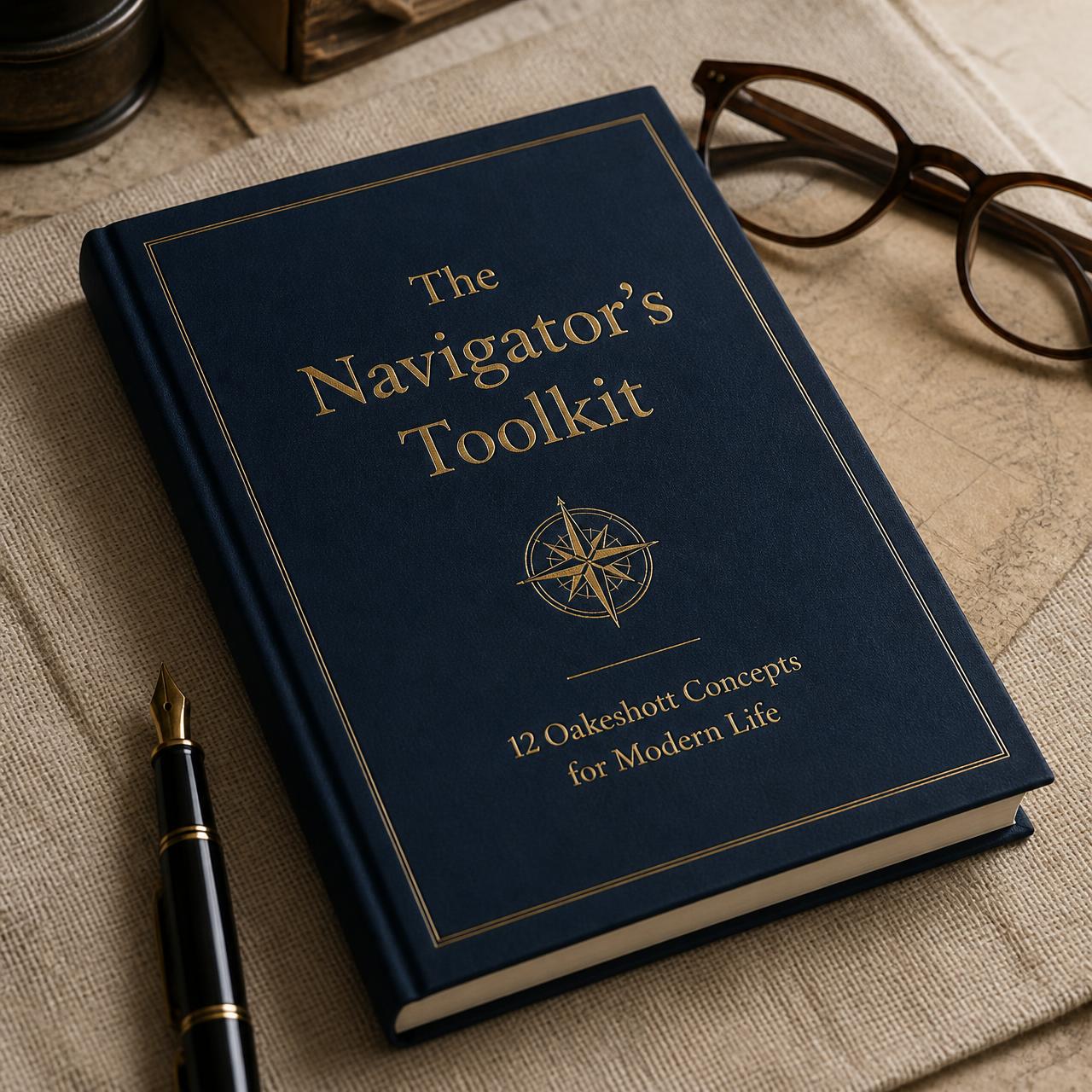
The Navigator's Toolkit — a navy hardcover field guide with muted gold foil title
The Private Difficulty

The hardest part is not only what changed. It's not having words for it.

  • Adult children now speak a moral language you don't recognize.
  • Conversations about values turn into arguments no one wins.
  • Decades of lived experience are treated as sentimentality.
  • Faith can feel mechanical — and admitting that feels shameful.
  • Long marriage, retirement, and church change raise questions you can't easily name.
  • Political commentary makes you angrier, but not clearer.

When you do not have language, you are left with only three options: silence, anger, or surrender.
None of them is enough.

The Cost of Staying Where You Are

Without clarity, the same conversations keep repeating.

Without the right concepts, the pattern is always the same:

A family conversation
becomes a contest.
A defense of tradition
sounds like nostalgia.
Lived wisdom
gets dismissed as sentiment.
Politics
becomes a search for saviors.
Retirement
feels like uselessness.
Legacy
becomes vague anxiety instead of active transmission.

This toolkit is not about collecting information. It is about breaking the pattern of confusion.

A New Opportunity

What if the problem was not your values —but the lack of precise vocabulary?

Michael Oakeshott offers a set of concepts that name what many thoughtful people have been living for years: rationalism, practical knowledge, the conservative disposition, attachment, politics as navigation, conversation versus argument, education as inheritance.

This toolkit does not ask you to become an academic. It turns those ideas into instruments for modern life.

The Unique Mechanism

The T · C · U Method

Trigger → Concept → Use

01Step 1

Trigger

Start with the situation you are living.

"A conversation with my adult child keeps turning into a fight."
02Step 2

Concept

Find the idea that names the pattern.

"Conversation vs. Argument."
03Step 3

Use

Apply it in a real conversation.

"Decide whether your goal is to win a verdict — or preserve the relationship."

Most philosophy books ask you to know the term before you can use the idea. This toolkit works the other way around.
You look up the situation. The toolkit hands you the concept.

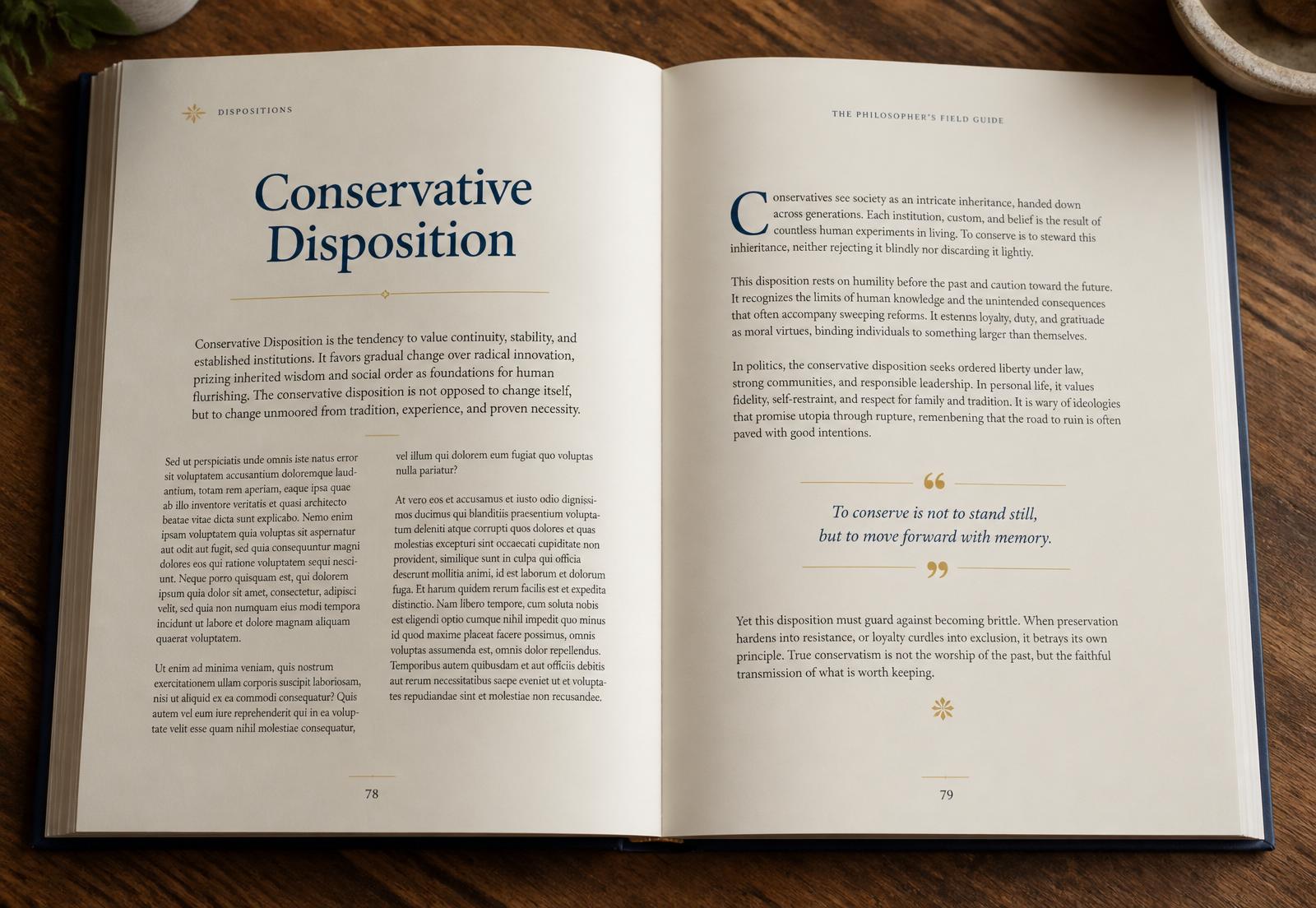
Interior spread of The Navigator's Toolkit showing a concept entry with serif headings and pull quote
Introducing

The Navigator's Toolkit

12 Oakeshott concepts for modern life — each defined, illustrated, and ready to use in the conversations that matter.

A practical PDF field manual from the Disposition channel. Built to be kept close: on your desktop, tablet, nightstand, or in a printed folder.

Its value is not in being read once. Its value is in being returned to whenever you need clarity.

What This Helps You Do

Concepts, translated into outcomes.

01

Name what is happening when experience is dismissed as “just nostalgia.”

02

Understand why practical knowledge matters more than abstract formulas.

03

Speak about conservatism as a disposition, not a partisan identity.

04

Reframe a long marriage as attachment, not failure.

05

Stop expecting politics to provide salvation.

06

Recognize when a family conversation has become an argument.

07

Understand education as inheritance, not just information.

08

Think about legacy as something handed on while you are alive.

09

Rebuild meaning in the second half of life through intrinsic goods.

10

See how abstract systems can destroy practical wisdom.

Inside the Toolkit

Everything that comes with your copy.

  • 12 practical Oakeshott concepts, each with plain-English explanation
  • A Situation Index — start with what you're actually living
  • Contemporary examples for every concept
  • "How to use it" sections for real conversations and decisions
  • One anchor line per concept (quotation or clearly labeled paraphrase)
  • A One-Page Cheat Card summarizing all 12 concepts
  • Source honesty note distinguishing direct quotes from paraphrases
The 12 Concepts

A complete map of the toolkit

  1. 01Rationalism
  2. 02Practical Knowledge
  3. 03The Conservative Disposition
  4. 04Attachment vs. Passion
  5. 05Politics as Navigation
  6. 06The Politics of Faith vs. Scepticism
  7. 07Intimations
  8. 08Conversation vs. Argument
  9. 09Education as Inheritance
  10. 10Inheritance
  11. 11Intrinsic vs. Instrumental Activity
  12. 12The Rationalist as the Enemy of the Practical
Demonstration

See how one situation becomes usable clarity.

Three real examples, straight from the toolkit — the same shape every entry uses.

Example 1
Conversation vs. Argument
Situation

"A conversation with my adult child keeps turning into a fight nobody wins."

Reframe

The goal may not be to win the point. The goal may be to preserve the conversation.

Use

Before the next conversation, decide which mode you are entering: argument, where someone must win — or conversation, where the relationship remains open.

Example 2
The Conservative Disposition
Situation

"I'm told my values are just nostalgia."

Reframe

This is not about wanting to turn back time. It is about attachment to real goods that still exist and should not be traded away casually.

Use

"I'm not mourning a lost world. I'm attached to something real that I still have, and I want a genuine reason before I trade it away."

Example 3
Intrinsic vs. Instrumental Activity
Situation

"Retirement made me feel useless."

Reframe

Your worth was never only in what you produced. Some of the highest human goods are done for their own sake.

Use

Ask a different question of the day: not only "What did I achieve?" but "What did I do because it was good to do?"

Get Instant Access for $19.90

Start with the situation you're living this week.

What Makes This Different

Built for use, not display.

Organized by life

The guide is organized by the situations you are actually living — not by academic terminology.

One consistent shape

Every concept: trigger, explanation, contemporary example, and practical use.

Source transparency

Direct quotations are clearly distinguished from paraphrases. No sleight of hand.

Written for readers

Designed for non-academics. Calm, precise, practical language throughout.

Objection Handling

You do not need to be a philosopher to use this.

Risk Reversal

The 7-Day Clarity Guarantee

Open the toolkit. Use the Situation Index. Look for one situation that sounds like something you are actually living. If you do not find at least one concept that gives you useful clarity, request a refund within 7 days.

No pressure. No complicated process. The product should earn its place on your desk.

The Offer

Get the complete toolkit today.

Main product

The Navigator's Toolkit — 12 Oakeshott Concepts for Modern Life

  • 12 concept entries — defined, illustrated, applied
  • The Situation Index
  • Printable One-Page Cheat Card
  • Contemporary examples for every concept
  • "How to Use It" sections
  • Anchor lines and source notes
  • Instant digital access (PDF)
Included bonuses
  • Hard Conversation Prep Sheet
    Walk into the next difficult conversation with a plan, not a script.
  • Legacy Reflection Page
    Turn vague anxiety about legacy into something you can hand on now.
  • Printable One-Page Cheat Card
    All 12 concepts on a single page for your desk or wall.
One-time payment
$19.90

Instant download. Yours to keep. Print if you like.

  • Full toolkit + 3 bonuses
  • Situation Index & Cheat Card
  • 7-Day Clarity Guarantee
Get Instant Access for $19.90

The conversations this toolkit addresses are already in your life. Start with the one you are living this week.

Final Questions

Everything else you might be wondering.

Start with the situation
you're living this week.

You do not need to become louder. You do not need to become angrier. You need the right words — words that name what you have lived, clarify what matters, and help you speak with dignity.

Get Instant Access for $19.90

Instant download · Practical PDF · 7-day clarity guarantee